


Induction vs Electric Stove Efficiency: The Ultimate 2026 Energy-Saving Comparison
August 17, 2026 | by Md. Samsul Haque
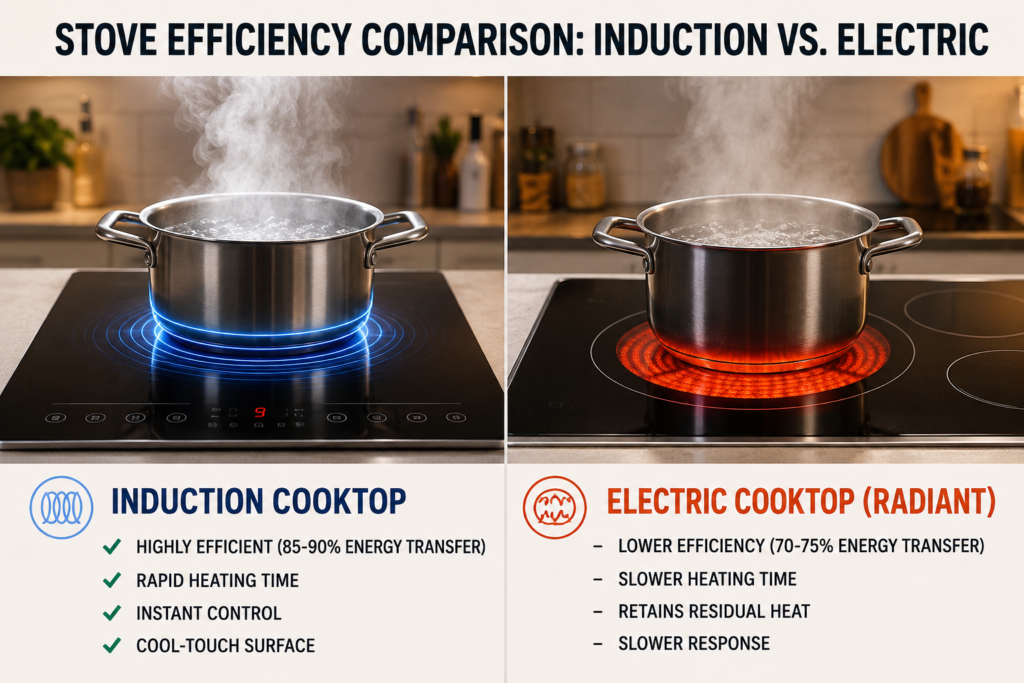
When choosing a new electric cooking appliance, induction vs electric stove efficiency is an important factor to consider. Both induction and conventional electric resistance stoves use electricity, but they transfer heat to cookware in different ways.
Traditional electric stoves use heating elements or coils to generate heat, which is then transferred to the cookware. Induction cooking uses electromagnetic energy to heat compatible cookware directly.
Because induction transfers heat more directly to the pan, it generally offers higher cooking efficiency, faster heating, and less wasted heat around the cookware. The U.S. Department of Energy says induction appliances can be up to 10% more efficient than conventional smooth-top electric ranges.
But does that mean induction is always the better choice? Not necessarily. Purchase price, cookware compatibility, cooking habits, and electrical requirements can also matter.Let’s compare the two.
Induction vs Electric Stove: How Do They Work?
How a Traditional Electric Stove Works
A conventional electric stove uses an electrical current to heat a resistance element. The element becomes hot and transfers heat to the cookware.
Depending on the model, the heating element may be exposed as a coil or located beneath a smooth glass-ceramic surface.
The process is relatively simple, but some energy is lost while heat moves from the heating element through the cookware.
How an Induction Stove Works
Induction cooking works differently. Instead of heating the burner first, an induction cooktop creates an electromagnetic field that generates heat directly inside compatible cookware.
This means the cookware itself becomes the primary source of heat. When the pan is removed, the induction heating process stops.
This direct heating is one of the main reasons induction cooktops are more efficient than conventional electric resistance models.
Induction vs Electric Stove Efficiency Comparison

To check the induction click here
To check the elective stove click here
| Feature | Induction Stove | Conventional Electric Stove |
|---|---|---|
| Heating method | Electromagnetic induction | Electrical resistance |
| Energy transfer | Directly into compatible cookware | Heating element → cookware |
| Efficiency | Generally higher | Generally lower |
| Heating speed | Very fast | Slower |
| Surface heat | Lower | Higher |
| Temperature control | Very responsive | Good but slower |
| Cookware | Requires compatible cookware | Works with most cookware |
| Initial cost | Usually higher | Often more affordable |
| Cleaning | Easy, smooth surface | Depends on design |
| Energy savings potential | Higher | Lower |
ENERGY STAR notes that induction cooking can be around 5–10% more efficient than conventional electric resistance cooking, while DOE similarly describes induction as up to 10% more efficient than conventional smooth-top electric ranges.
Why Is Induction More Efficient?
The biggest difference is where the heat is produced.
With a conventional electric stove:
Electricity → heating element → cookware → food
With induction:
Electricity → electromagnetic field → cookware → food
Because induction heats the cookware directly, less heat is released into the surrounding kitchen.
ENERGY STAR states that induction transfers approximately 85% of the heating energy to the cookware.
That doesn’t mean every induction cooking session will automatically use 15% less electricity than every electric stove. Actual energy consumption depends on the cookware, cooking temperature, food, pan size, and cooking time.
Induction vs Electric Stove: Which Boils Water Faster?
Induction generally wins when it comes to heating speed.
ENERGY STAR describes induction as offering the fastest cooking time among common cooking technologies and notes that some induction cooktops can boil water in as little as two minutes.
Traditional electric resistance cooktops can also heat water effectively, but they typically take longer because the heating element must first transfer heat to the cookware.
For people who frequently boil water, cook pasta, prepare soups, or need rapid temperature changes, induction can be particularly convenient.
Which Uses Less Electricity?
Induction generally uses less electricity for the same cooking task than conventional electric resistance cooking.
However, the difference is not enormous in every situation.
ENERGY STAR’s research indicates induction cooking tops are approximately 5–10% more efficient than conventional electric resistance units.
So if your main goal is reducing cooking energy consumption while staying with electric cooking, induction has an advantage.
For example, if two appliances perform the same cooking task but one transfers more of the electrical energy into the cookware, the more efficient appliance needs less wasted energy to accomplish that task.
Induction vs Electric Stove: Which Is Better for Your Kitchen?
Choose Induction If:
- You want higher cooking efficiency
- You want faster heating
- You frequently boil water
- You want precise temperature control
- You prefer a cooler cooking surface
- You are comfortable buying induction-compatible cookware
Induction is especially attractive for people who cook frequently and want a combination of speed and energy efficiency.
Choose Conventional Electric If:
- You want a lower initial purchase price
- You already own a large collection of cookware
- You don’t want to replace your pans
- You prefer a simple cooking system
- Maximum efficiency isn’t your top priority
A conventional electric stove can still be a practical and efficient choice, particularly if your budget is limited.
Does Induction Require Special Cookware?
Yes.
Induction cooktops require cookware that responds to a magnetic field.
A simple test is to place a magnet against the bottom of your cookware. If the magnet sticks firmly, the cookware is generally compatible with induction.
ENERGY STAR says flat-bottomed cast iron, stainless steel, and enameled cast iron cookware can work with induction, although compatibility ultimately depends on the specific cookware.
So before purchasing an induction stove, check the cookware you already own.
Is Induction More Expensive Than Electric?
The answer depends on the specific model.
Conventional electric stoves can be less expensive upfront, while induction models may cost more because of their more advanced heating technology.
However, the purchase price is only one part of the total cost.
You should also consider:
- Electricity consumption
- Cooking frequency
- Expected appliance lifespan
- Cookware replacement costs
- Installation requirements
- Available rebates or incentives
If you cook frequently, the efficiency and speed advantages of induction may make the higher purchase price more worthwhile.
Induction vs Electric Stove: Safety and buying guide
Induction has another important advantage: the cooktop itself generally stays cooler than a conventional electric heating element.
Because induction generates heat primarily inside the cookware, removing the pan stops the active induction heating.
This can reduce the risk of accidentally touching an extremely hot heating element.
However, the glass surface can still become hot because heat from the cookware transfers back to the surface. So induction should not be treated as completely cool or burn-proof.
To check the induction click here
To check the elective stove click here
What About Kitchen Heat?
Another advantage of induction is reduced heat escaping into the surrounding kitchen.
Because more of the energy goes directly into the cookware, less heat is released from the cooking surface into the room.
ENERGY STAR notes that this can also reduce the workload on HVAC equipment because less unwanted heat enters the kitchen environment.
This can be particularly useful during hot weather.
Pros and Cons of Induction
Pros
- Higher efficiency than conventional electric resistance cooking
- Faster heating
- Excellent temperature control
- Less heat released into the kitchen
- Smooth surface is easy to clean
- Cooktop generally stays cooler than traditional electric elements
Cons
- Higher upfront cost on some models
- Requires compatible cookware
- Some cookware may need to be replaced
- Requires electricity
- Glass surface can still be damaged if handled improperly
Pros and Cons of Conventional Electric Stoves
Pros
- Usually affordable
- Works with most cookware
- Familiar and simple operation
- No gas connection required
- Available in many styles and sizes
Cons
- Generally less efficient than induction
- Slower heating
- Heating elements remain hot after cooking
- More heat can escape into the kitchen
- Temperature changes may be slower
Induction vs Electric Stove Efficiency: Which One Wins?
If energy efficiency and cooking speed are your main priorities, induction is the better choice.
Research and ENERGY STAR information consistently show that induction is more efficient than conventional electric resistance cooking. DOE estimates that induction can be up to 10% more efficient than conventional smooth-top electric ranges, while ENERGY STAR describes induction as about 5–10% more efficient than conventional electric resistance units.
However, conventional electric stoves remain attractive because they are often cheaper initially and work with a wider range of cookware.
Quick Verdict
Best for efficiency: Induction
Best for speed: Induction
Best for cookware compatibility: Conventional electric
Best for lower upfront cost: Conventional electric
Best for precise temperature control: Induction
Best for reducing kitchen heat: Induction
Frequently Asked Questions
Is induction more efficient than an electric stove?
Yes. Induction is generally more efficient than conventional electric resistance cooking because it transfers heat directly into compatible cookware. DOE says induction can be up to 10% more efficient than conventional smooth-top electric ranges.
Does induction use less electricity?
Generally, yes, when performing the same cooking task. Its more direct heat transfer means less energy is lost compared with conventional resistance cooking.
Is induction cheaper to run than electric?
It can be, particularly for frequent cooking, because of its higher efficiency. However, your actual savings depend on electricity rates, cooking habits, appliance efficiency, and purchase price.
Can I use my existing pans on an induction stove?
Some can. Cast iron and many stainless-steel pans are compatible, but you should check each pan. A magnet test is a simple way to determine whether cookware is likely to work.
Is an induction stove worth it?
For people who cook frequently and value efficiency, fast heating, and precise control, induction can be worth considering. If your priority is a lower initial cost and broad cookware compatibility, conventional electric may be more practical.
Conclusion
When comparing induction vs electric stove efficiency, induction comes out ahead in energy transfer, heating speed, and temperature responsiveness. Its ability to heat compatible cookware directly means less energy is wasted compared with conventional electric resistance cooking.
However, conventional electric stoves remain a practical choice for shoppers who want a lower upfront cost and compatibility with almost any cookware.
Overall, choose induction if efficiency and fast cooking are your priorities. Choose conventional electric if affordability and cookware compatibility matter more.
IF you want to see the reviews of the product you can also check in social media site of fb here and if you want to see the other article click here.
RELATED POSTS
View all


Amazon Best Selling Products: (2026) Top picks
September 18, 2026 | by Md. Samsul Haque
What Is the Best Countertop Dishwasher in 2026?
September 27, 2026 | by Md. Samsul Haque
5 Best Washing and Drying Machine Sets in 2026 – Reviews & Buying Guide
August 8, 2026 | by Md. Samsul Haque